
Two-dimensional electron gases (2DEG) are a fundamental element of modern electronics. Among the various systems capable of hosting them, complex oxide heterostructures are particularly noteworthy. In addition to offering very high electron mobility, these systems allow unique properties to be exploited, such as spin-orbit coupling and strong electron correlations. These specific features pave the way for new functionalities, while creating bridges to fields such as spintronics and photonics. In this context, the ability to manipulate 2DEGs using external stimuli is the holy grail. In this study, the researchers demonstrated the instantaneous creation of a 2DEG at the interface between two oxides where such an electronic state is otherwise absent. This 2DEG disappears just as quickly when the light is turned off. The result is a giant photoconductance effect: under illumination, the electrical conductance is up to five orders of magnitude higher than in the dark! These effects are observed at the interface between thin layers of Nd1-xSrxNiO2 (x = 0, 0.05, and 0.2) and their SrTiO3 substrate.
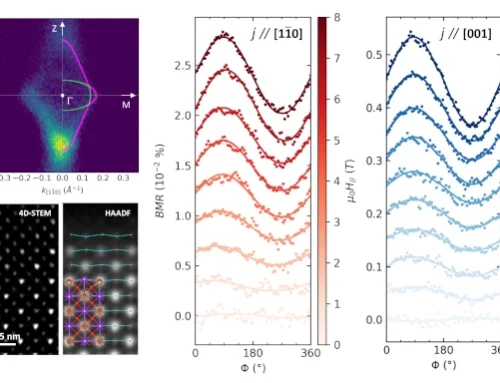
To obtain these results, we epitaxially deposited ultrathin layers of Nd1-xSrxNiO3 perovskite on SrTiO3 using pulsed laser ablation. Subsequently, a topotactic reduction process was used to obtain the infinite-layer phase Nd1-xSrxNiO2. Electrical transport measurements under ultraviolet and visible light illumination revealed photoconductance effects and their dependence on photon energy. To identify the microscopic mechanisms explaining the generation of the 2DEG, the team combined an in-depth study of the interface using transmission electron microscopy (4D-STEM) and electron energy loss spectroscopy (EELS) with advanced density functional theory calculations. They thus demonstrated that the key elements for 2DEG generation are structural and electronic reconstructions at the NdNiO2/SrTiO3 interface, as well as the existence of an intrinsic interfacial electric field. This field promotes the occupation of the high-mobility Ti-3dxy conduction band by photoexcited electrons, attracting them to the interface and separating them from the holes left in the Ti valence band.
These results are very interesting, both from a fundamental point of view and for their potential applications. On the one hand, they reveal how slight variations in the electronic structure at the interface—whether related to atomic layer terminations, local oxidation state, or temperature—can significantly modulate the confinement and distribution of photo-generated carriers in the interface bands. On the other hand, this detailed understanding of the underlying microscopic mechanisms opens up promising prospects for engineering the photo-response of strongly correlated electrons. Among the applications envisaged are, for example, the optical control of the superconducting state of infinite-layer nickelates.
The work presented in this article is the result of a collaboration between LAF and several laboratories in France (IPCMS, LPS, SOLEIL), Germany (University of Duisburg-Essen), Spain (Universidad Complutense de Madrid), and the United States (University of Florida). This work is part of a broader effort at the CNRS dedicated to manipulating electronic states with light in strongly correlated oxides and their heterostructures, including superconductors, spintronic, and electronic materials, within the framework of the EIC Pathfinder projects “JOSEPHINE” and “SPINMAT” of the PEPR SPIN.
Reference:
Giant photoconductance at infinite-layer nickelate/SrTiO3 interfaces via an optically induced high-mobility electron gas
David Sanchez-Manzano, G. Krieger, A. Raji, B. Geisler, H. Sahib, V. Humbert, H. Jaffrès, J. 5 Santamaría, R. Pentcheva, A. Gloter, D. Preziosi et Javier E. Villegas
Nature Materials (2025) Lien open access : https://rdcu.be/eKlL9
Référence :
Giant photoconductance at infinite-layer nickelate/SrTiO3 interfaces via an optically induced high-mobility electron gas
David Sanchez-Manzano, G. Krieger, A. Raji, B. Geisler, H. Sahib, V. Humbert, H. Jaffrès, J. 5 Santamaría, R. Pentcheva, A. Gloter, D. Preziosi et Javier E. Villegas
Nature Materials (2025) Lien open access : https://rdcu.be/eKlL9

(a) Transmission electron microscopy image combined with electron energy loss spectroscopy of an NdNiO2/SrTiO3 heterostructure. (c) Electrical resistance vs. temperature under illumination and in the dark, showing the giant photoconductance effect. (d) Energy bands and Fermi level at the interface and in several atomic planes from it, calculated using density functional theory