
For years, the orbital Edelstein effect (OEE), which converts an electric field into a non-equilibrium orbital polarization, remained theoretically intriguing but experimentally elusive. While signatures of OEE had been reported, its microscopic origins and quantitative validation were poorly understood.
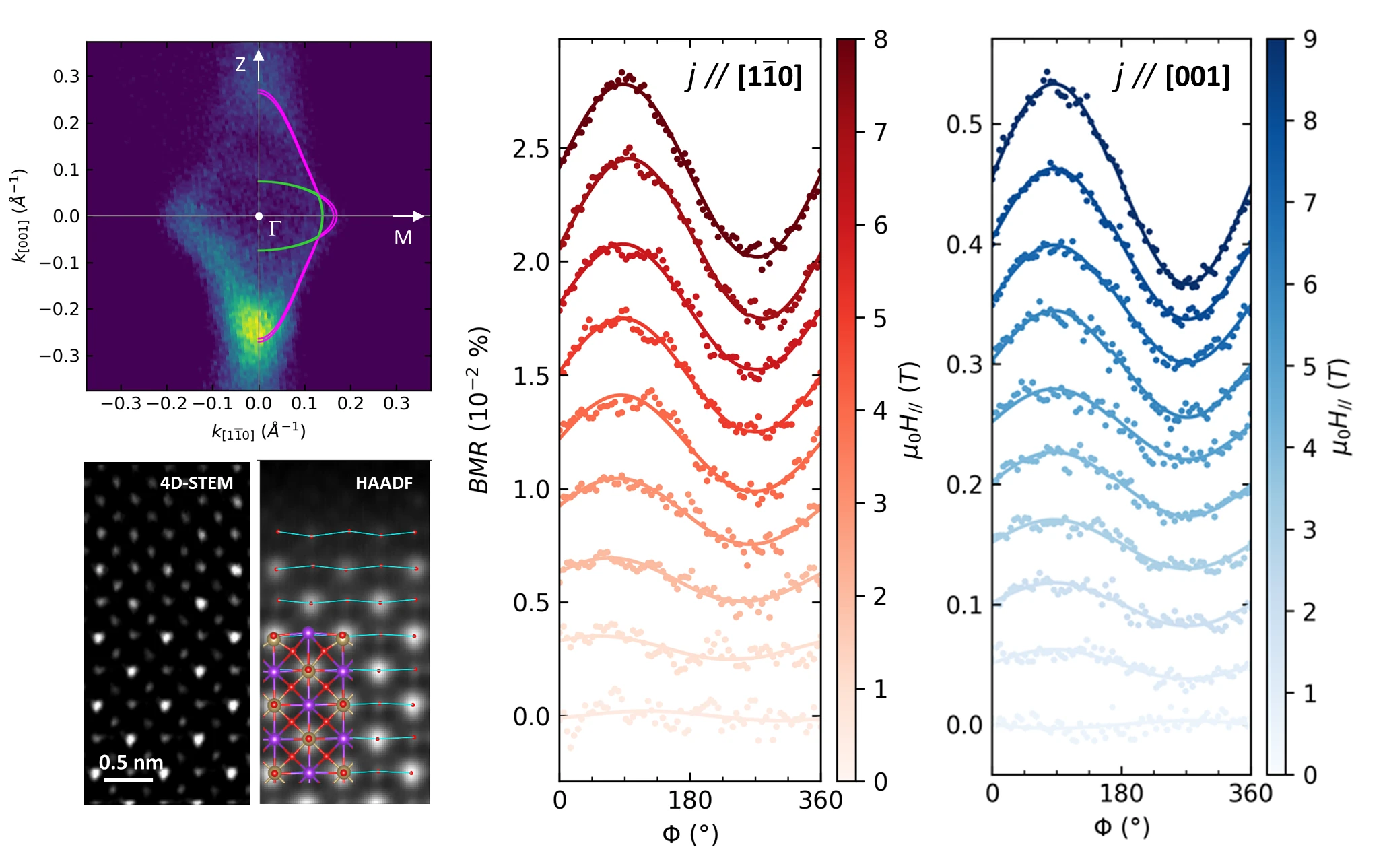
In our recent work published in Advanced Materials, we focused on KTaO₃(110) two-dimensional electron gases (2DEGs), a model system where strong spin-orbit coupling and broken inversion symmetry enable robust spin and orbital textures. By combining scanning transmission electron microscopy (STEM), electron energy-loss spectroscopy (EELS), density-functional theory (DFT), and angle-resolved photoemission spectroscopy (ARPES), we directly linked the atomic structure of KTaO₃(110) interfaces to their electronic band dispersions. Our calculations and experiments revealed anisotropic Fermi surfaces with mixed orbital character, where the OEE counterbalances the well known spin Edelstein effect (SEE). Harmonic magnetotransport measurements confirmed that the OEE contributes ~20% to the total signal, validating its role in the observed spin-orbitronic response.
This work establishes KTaO₃(110) as a promising platform for orbitronics, where orbital polarization could be harnessed for next-generation spintronic devices. As superconductivity is also present in systems, the interplay between orbital and spin degrees of freedom can also offer new insights into superconducting pairing mechanisms.
This research is the product of a collaboration between the Laboratoire Albert Fert, the Laboratoire de Physique des Solides (LPS), Synchrotron SOLEIL, MPI Halle and Halle University.
Orbital and Spin Edelstein Effects in KTaO3(110) Two-Dimensional Electron Gases
H. Witt, A. Raji, S. Mallik, et al., Advanced Materials (2026): e73899.